
Embarking on identifying Florida’s diverse trees requires understanding its unique ecosystems. This guide provides essential knowledge for recognizing the state’s remarkable flora.

Why Identify Florida Trees?
Understanding Florida’s trees is crucial for appreciating the state’s biodiversity and ecological health. Accurate tree identification supports conservation efforts, as native trees are protected on state lands managed by the Florida Department of Environmental Protection. Knowing tree species aids in habitat restoration projects, like those focused on longleaf pine and mangrove forests.
Furthermore, identifying trees enhances outdoor experiences, allowing for a deeper connection with nature. It’s also vital for understanding the role trees play in Florida’s ecosystems, from providing wildlife habitat to influencing water quality. Resources like “The Trees of Florida: A Reference and Field Guide” empower individuals to learn and contribute to the preservation of these valuable natural assets.
Challenges of Florida Tree Identification
Identifying Florida trees presents unique difficulties due to the state’s incredible plant diversity. With nearly five hundred species, as detailed in resources like “The Trees of Florida,” mastering identification requires dedication. Hybridization between species adds complexity, blurring distinct characteristics. The sheer volume of plants can be overwhelming for beginners, necessitating patience and reliable tools.
Furthermore, variations within a single species, influenced by environmental factors, can create confusion. Utilizing apps like PlantSnap can assist, but field experience remains invaluable. The rapid growth and changing conditions in Florida’s ecosystems also mean constant learning is essential for accurate identification.
Common Florida Tree Families
Florida boasts prominent tree families like Palm (Arecaceae), Pine (Pinaceae), and Laurel (Lauraceae). Understanding these groups simplifies identification through shared characteristics and features.
Palm Family (Arecaceae)
The Palm Family, or Arecaceae, is exceptionally well-represented in Florida’s landscape, showcasing a remarkable diversity of forms and sizes. Identifying palms often centers around their unique leaf structures – either palmate (fan-shaped) or pinnate (feather-like). Trunks can be solitary or clustered, smooth or textured with leaf bases.
Florida’s native palms, such as the Cabbage Palm (Sabal palmetto), are iconic symbols of the state. Introduced species, like the Royal Palm (Roystonea regia), add to the visual splendor. Key identification features include the absence of branches and the presence of a crownshaft in some species. Observing fruit and flower structures can also aid in accurate identification within this widespread and ecologically important family.

Pine Family (Pinaceae)
Florida boasts several pine species within the Pinaceae family, crucial components of its diverse ecosystems. Identifying pines relies heavily on needle characteristics – length, number per bundle, and color. Cone morphology is also a key diagnostic feature, varying in size, shape, and scale texture.
The Longleaf Pine (Pinus palustris), a historically dominant species, is recognized by its exceptionally long needles and open, park-like growth form. Slash Pine (Pinus elliottii) and Loblolly Pine (Pinus taeda) are also common. Bark characteristics, becoming furrowed with age, provide additional clues. Understanding pine identification is vital, given their ecological and economic significance in Florida’s forests.
Laurel Family (Lauraceae)
The Laurel Family (Lauraceae) presents intriguing identification challenges in Florida, featuring aromatic trees and shrubs. A defining characteristic is the presence of simple, alternate leaves, often with a noticeable fragrance when crushed. Leaf venation is typically pinnate, meaning veins branch off a central midrib.
Redbay (Persea borbonia) and Swampbay (Persea palustris) are prominent examples, distinguished by their reddish hues and preference for moist habitats. Identifying features include smooth, grayish bark and small, black fruits. Careful observation of leaf shape, size, and scent is crucial for accurate Laurel family tree identification within Florida’s varied landscapes.
Identifying Trees by Leaf Type
Leaf characteristics are fundamental to Florida tree identification. Examining leaf arrangement – simple, compound, opposite, or alternate – provides crucial clues for species determination.
Simple Leaves
Simple leaves possess a single, undivided blade attached to the twig by a petiole. This is a key characteristic when beginning Florida tree identification. Recognizing the shape, margin (smooth or toothed), and venation patterns within simple leaves is crucial.
Florida boasts a wide array of trees with simple leaves, varying greatly in appearance. Consider the leaf’s overall form – is it oval, lance-shaped, or rounded? Note if the edges are smooth (entire), finely toothed (serrate), or coarsely toothed. Venation, the pattern of veins, can be palmate (radiating from a single point) or pinnate (branching from a central vein).
These details, combined with other features like bark and overall tree shape, will significantly narrow down the possibilities when identifying Florida’s diverse tree species.
Opposite Simple Leaves
Opposite simple leaves grow in pairs directly across from each other on the twig. This arrangement is a fundamental characteristic for identifying specific Florida tree families, notably within the Laurel Family (Lauraceae). Observing this leaf arrangement immediately eliminates many possibilities.
Common Florida trees exhibiting opposite simple leaves include various species of ash, maple, and dogwood. Pay close attention to the leaf shape and margin – are they oval with smooth edges, or lobed with toothed margins? The presence of specific features, like winged petioles in some maple species, further aids identification.
Remember to consider the overall tree form and bark characteristics alongside the leaf arrangement for accurate species determination.
Alternate Simple Leaves
Alternate simple leaves emerge individually along the twig, not in opposing pairs. This pattern is prevalent across numerous Florida tree species, making it a crucial identification feature. The Pine Family (Pinaceae), for example, commonly displays alternate simple leaves, specifically needles.
Look for trees like live oak, sweetgum, and many birch varieties exhibiting this leaf arrangement. Note the leaf shape – lanceolate, ovate, or elliptical – and examine the leaf margin for serrations or smooth edges. The presence of stipules (small appendages at the base of the leaf stalk) can also be a helpful clue.
Combining leaf arrangement with bark texture and overall tree shape will significantly refine your identification process.
Compound Leaves
Compound leaves are characterized by blades divided into multiple leaflets, all attached to a single petiole (leaf stalk). This differs significantly from simple leaves, which have a single, undivided blade. Identifying compound leaves is a key step in Florida tree identification.
Florida boasts trees with both palmately and pinnately compound leaves. Palmately compound leaves radiate from a central point, resembling fingers on a hand, while pinnately compound leaves have leaflets arranged along a central axis, like a feather.
Consider the number of leaflets, their shape, and arrangement to narrow down possibilities. Careful observation of these features will unlock accurate tree identification.
Palmately Compound Leaves
Palmately compound leaves exhibit leaflets radiating outwards from a single point, much like the fingers of a hand extending from the palm. This distinct arrangement is a crucial characteristic for identification within Florida’s diverse tree species.
A prime example is the Brabejum stellatifolium, though less common in Florida, illustrates this form perfectly. Observing the number of leaflets – typically five to seven – and their overall shape (ovate, lanceolate) are key.
Pay attention to the texture and any unique features of the leaflets. Careful examination of these details will significantly aid in pinpointing the specific tree species.
Pinnately Compound Leaves
Pinnately compound leaves feature leaflets arranged along a central stalk, resembling a feather. This leaf type is prevalent among many Florida trees, making its recognition vital for accurate identification. The arrangement – whether odd-pinnate (with a terminal leaflet) or even-pinnate (lacking a terminal leaflet) – is a primary distinguishing feature.
Consider the Casuarina equisetifolia (Australian Pine), a common Florida species exhibiting pinnately compound leaves. Note the length of the leaf stalk (rachis) and the size, shape, and texture of the individual leaflets.
Observing leaflet attachment (sessile or petiolulate) and margin characteristics further refines identification.

Identifying Trees by Bark
Tree bark offers crucial clues for identification, varying significantly in texture, color, and pattern. Observing these characteristics aids in narrowing down possibilities.
Smooth Bark
Smooth bark, as the name suggests, feels relatively untextured to the touch. This characteristic isn’t always consistent across the entire tree; younger branches often exhibit smoother surfaces compared to the base. Several Florida trees showcase this trait, including American Beech (Fagus grandifolia) and certain maple species. However, caution is advised, as smooth bark can change with age or environmental factors.
Identifying trees solely by bark can be misleading, so combining this observation with leaf shape, arrangement, and overall tree form is crucial. Look for lenticels – small, corky pores – which may be visible on the smooth surface. These aid in gas exchange and can be a distinguishing feature. Remember to consider the tree’s location and habitat when making your identification.
Rough and Furrowed Bark
Rough and furrowed bark is characterized by deep ridges and grooves, creating a textured appearance. This bark type often develops as the tree ages and expands, resulting in a complex pattern. Many iconic Florida trees, like pines and oaks, display this feature prominently. Longleaf Pine (Pinus palustris), for example, has thick, scaly bark with deep furrows.
The depth and pattern of the furrows can vary significantly between species. Observing the color, width, and shape of the ridges provides valuable clues for identification. Consider the overall bark thickness as well. Remember that bark characteristics can change with height on the tree, so examine multiple sections. Combining bark analysis with leaf and branch features is essential for accurate identification.
Peeling Bark
Peeling bark presents a distinctive characteristic where the outer layers of bark separate and flake off, revealing underlying layers. This process can occur in strips, plates, or curls, creating a visually striking appearance. Several Florida trees exhibit peeling bark, offering a helpful identification feature. Observing the color and texture of both the peeling and underlying bark is crucial.
The manner of peeling – whether in long strips or small flakes – can differentiate species. Some trees peel consistently, while others only peel under certain conditions. Consider the pattern and extent of peeling. Combining this observation with leaf shape and arrangement will significantly improve identification accuracy. Remember to examine multiple areas of the trunk for a comprehensive assessment.

Florida’s Iconic Trees & Protected Species
Florida safeguards native trees like the Longleaf Pine and various Mangrove species, crucial for habitat restoration and representing the state’s natural heritage.
Longleaf Pine (Pinus palustris)
The Longleaf Pine is a keystone species, historically dominating vast areas of the Southeastern United States, including Florida. Identifying it involves noting its long needles, typically 8-18 inches in length, growing in bundles of three. Its bark is thick, reddish-brown, and deeply furrowed with age.
These pines are characterized by their open, park-like appearance, a result of frequent, low-intensity fires which they are adapted to survive. The Florida Department of Environmental Protection actively works to restore Longleaf Pine forests, recognizing their ecological importance. Look for its distinctive cones, 6-10 inches long, with scales that possess a small prickle. Recognizing this iconic tree is vital for understanding Florida’s natural landscapes and conservation efforts.
Mangrove Trees (Rhizophora, Avicennia, Laguncularia)
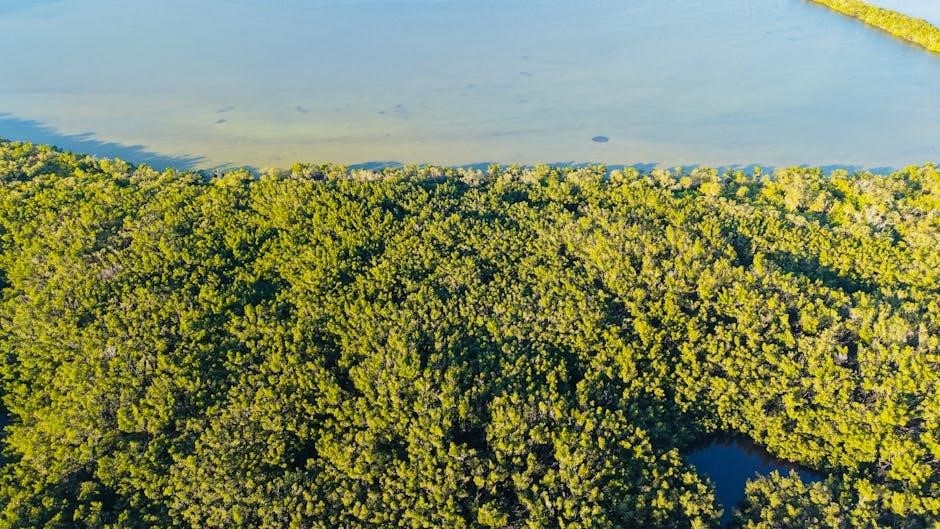
Mangrove trees are crucial components of Florida’s coastal ecosystems, providing habitat and shoreline protection. Three main genera – Rhizophora, Avicennia, and Laguncularia – are found in the state. Rhizophora (red mangrove) is identified by its prop roots, arching down into the water. Avicennia (black mangrove) has pneumatophores – root extensions that stick up from the soil.
Laguncularia (white mangrove) typically lacks prominent prop roots. The Florida Department of Environmental Protection actively partners in mangrove forest restoration projects. Identifying mangroves involves observing their unique root systems and tolerance to saltwater. These trees are vital for biodiversity and buffering against storms, making their recognition essential for coastal understanding.
Resources for Florida Tree Identification
Numerous field guides and online tools simplify Florida tree identification. Books like “The Trees of Florida” and apps like PlantSnap offer detailed assistance.
Field Guides & Books
For in-depth study, comprehensive field guides remain invaluable resources. “The Trees of Florida: A Reference and Field Guide” by Nelson, Gil, and Cook is a standout choice, presenting detailed descriptions of nearly 500 species.
This book utilizes illustrations and clear outlines, enabling users to pinpoint specific trees based on observable physical characteristics like leaf shape, bark texture, and overall form. These guides are particularly useful when exploring remote areas lacking internet connectivity.
They offer a tactile learning experience and allow for focused observation without digital distractions. Investing in a quality field guide is a cornerstone of successful Florida tree identification, providing a lasting reference for years to come.
Online Identification Tools & Apps
Modern technology offers convenient digital solutions for tree identification. PlantSnap, for example, is an app designed to identify plants, trees, and even mushrooms using image recognition technology. These tools allow for quick preliminary identification in the field, simply by uploading a photograph of the tree’s leaves, bark, or flowers.
While not always foolproof, these apps can significantly narrow down possibilities and accelerate the identification process. Numerous websites also provide interactive keys and databases, offering detailed information and comparison tools.
However, remember to cross-reference findings with reliable sources for accuracy, as app identifications aren’t always definitive.


Leave a Reply
You must be logged in to post a comment.